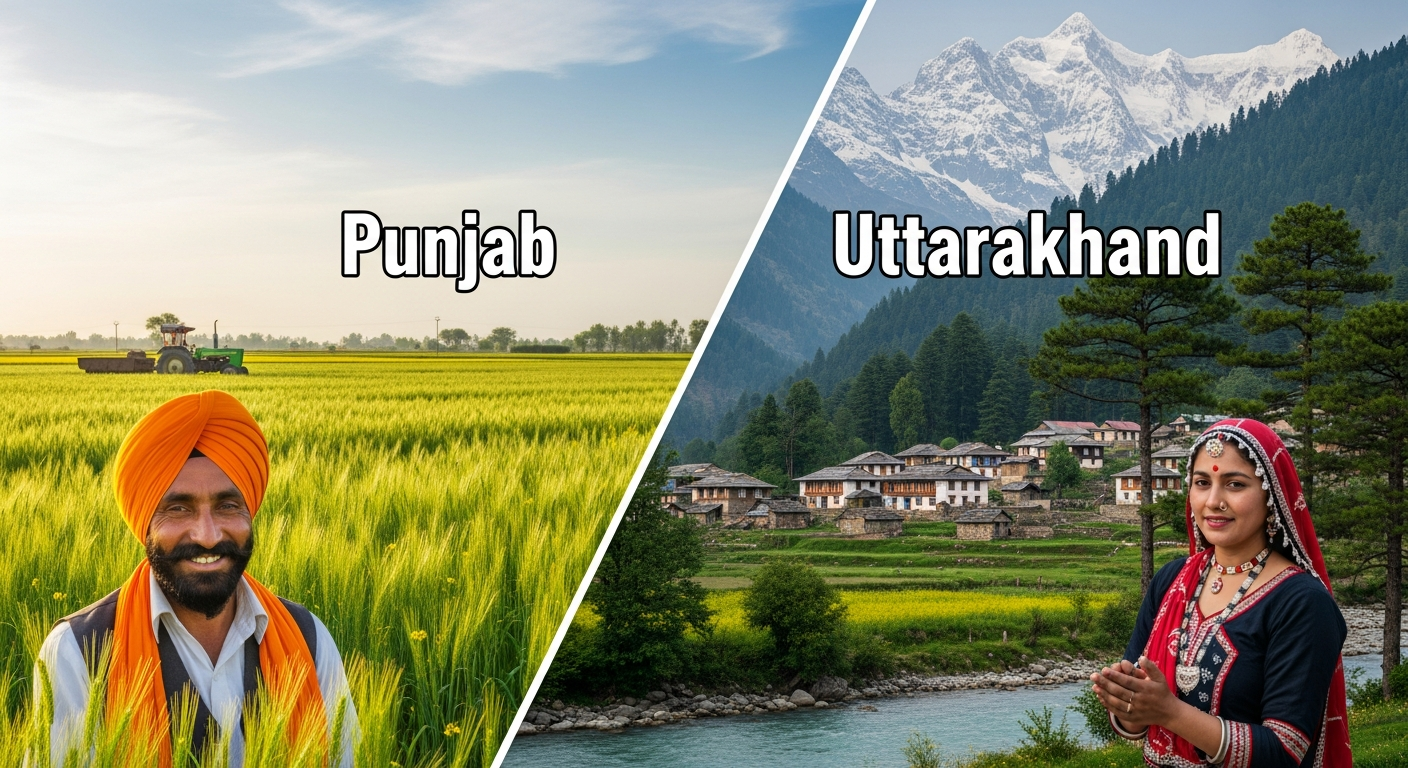
India is a country of immense diversity, and each of its states has a unique cultural, geographical, and socio-economic identity. Among these states, Punjab vs Uttarakhand stand out for their distinct characteristics. While Punjab is often referred to as the “Granary of India” due to its rich agricultural land, Uttarakhand is known as the “Land of Gods” for its spiritual significance and scenic beauty. Comparing these two states—Punjab vs Uttarakhand—highlights differences in geography, economy, culture, lifestyle, and development.
Geography and Location
Punjab is located in the northwestern part of India. It shares an international border with Pakistan, and its terrain primarily consists of fertile plains fed by rivers like the Sutlej, Beas, and Ravi. The climate in Punjab is subtropical, with hot summers and cold winters. It is well-known for its extensive irrigation systems, making it one of the most agriculturally productive regions in India.
Uttarakhand, on the other hand, lies in the northern part of India and is predominantly mountainous. It is nestled in the Himalayas and shares international borders with China (Tibet) and Nepal. Uttarakhand’s terrain is varied, featuring high peaks, valleys, and dense forests. The state has a temperate climate in the hills and a subtropical climate in the plains. Rivers like the Ganges and Yamuna originate here, adding to its ecological significance.
History and Formation
Punjab has a rich historical background influenced by various empires such as the Mauryas, Mughals, and Sikhs. Sikhism emerged in Punjab in the 15th century, which has played a significant role in shaping the region’s culture and identity. The state as it exists today was formed in 1966 after the reorganization of the Indian states, splitting from Haryana and Himachal Pradesh.
Uttarakhand, historically known as Uttaranchal until 2007, has a distinct historical identity tied to ancient Hindu texts and pilgrimage sites. It was formed in the year 2000, carved out of Uttar Pradesh, to address the aspirations of the hilly region’s people. Its history is closely tied to temples, monasteries, and the freedom movement of India.
Culture and Traditions
Punjab is famous for its vibrant culture, music, and dance. Bhangra and Gidda are iconic folk dances that reflect the energetic spirit of the Punjabi people. Festivals like Vaisakhi, Lohri, and Diwali are celebrated with great enthusiasm. The traditional attire includes turbans for men and colorful suits for women, representing the lively culture of the region.
Uttarakhand, in contrast, has a more serene and spiritual culture. The state is renowned for its religious traditions and pilgrimage sites like Haridwar, Rishikesh, Badrinath, and Kedarnath. Folk music and dance in Uttarakhand, such as Garhwali and Kumaoni performances, are deeply connected to nature and local rituals. Traditional attire often includes woolen clothing in the hills to adapt to the cooler climate.
Economy and Occupation
Punjab’s economy is primarily agrarian. It is a leading producer of wheat, rice, and dairy products. The state benefits from modern irrigation systems, making farming highly productive. Industries such as textiles, manufacturing, and food processing also contribute to its economy. Punjab has a high per capita income compared to many Indian states due to its agricultural and industrial strength.
Uttarakhand’s economy is more diversified. While agriculture remains important, tourism, hydropower, and forestry play significant roles. The state attracts millions of tourists annually due to its religious sites, trekking routes, and natural beauty. Small-scale industries like handicrafts, woolen goods, and herbal products are common. Uttarakhand also focuses on renewable energy, particularly hydroelectric power, given its mountainous terrain.
Tourism Potential
Punjab offers a unique cultural tourism experience. Visitors often explore historical sites like the Golden Temple in Amritsar, Jallianwala Bagh, and various forts and palaces. The Punjabi cuisine, rich in flavors, also attracts tourists who want to experience local food culture.
Uttarakhand, however, is primarily known for nature and spiritual tourism. The Himalayan landscapes offer trekking, skiing, and adventure sports. Pilgrimage tourism is central, with places like Haridwar, Rishikesh, and the Char Dham attracting devotees from across India and the world. The state’s serene environment provides opportunities for wellness and yoga retreats, making it a hub for spiritual and health tourism.
Education and Literacy
Punjab has a well-established educational infrastructure. Cities like Chandigarh, Ludhiana, and Amritsar host universities, technical institutes, and research centers. The literacy rate in Punjab is relatively high, and the state emphasizes both academic and vocational training.
Uttarakhand has made significant progress in education, particularly in rural and hilly regions. Institutions like the Indian Institute of Technology (IIT) Roorkee, Forest Research Institute in Dehradun, and various universities contribute to higher education. However, challenges remain in providing quality education to remote areas due to difficult terrain.
Infrastructure and Connectivity
Punjab enjoys robust infrastructure and connectivity. Its road and rail networks are well-developed, connecting major cities and rural areas efficiently. The state also benefits from proximity to Delhi and other northern cities, facilitating trade and mobility.
Uttarakhand faces unique challenges due to its mountainous geography. Road connectivity is limited in hilly areas, and landslides or floods can disrupt transport. However, the plains of Uttarakhand, such as Haridwar and Dehradun, have good infrastructure. Airports like Jolly Grant in Dehradun improve air connectivity, and tourism-related development is gradually improving accessibility.
Agriculture and Food Security
Punjab is known as the “breadbasket of India.” Its agriculture is highly mechanized and supported by the Green Revolution. Major crops include wheat, rice, sugarcane, and maize. Dairy farming is also prominent, with Punjab producing large quantities of milk and milk products. The state plays a crucial role in India’s food security and export of agricultural goods.
Uttarakhand, by contrast, has limited arable land due to its mountainous terrain. Agriculture is mainly subsistence-based, focusing on crops like rice, wheat, and maize in valleys. Horticulture, especially apple, citrus, and medicinal plants, is significant. The state promotes organic farming and agro-tourism to boost local income.
Festivals and Celebrations
Punjab’s festivals are marked by exuberance and community participation. Vaisakhi celebrates the harvest season, while Lohri signifies the end of winter. Diwali and Gurpurabs are celebrated with rituals, fairs, and gatherings, highlighting communal harmony.
Uttarakhand’s festivals are more spiritual and seasonal. Makar Sankranti, Ganga Dussehra, and Nanda Devi Mela celebrate nature and divine entities. Local fairs, traditional songs, and dances form an essential part of community life, emphasizing a connection with nature and heritage.
Demographics and Lifestyle
Punjab has a diverse population with a majority of Sikhs and significant Hindu and Muslim communities. The lifestyle is largely urbanized in cities, while rural areas maintain traditional practices. Punjabis are known for their hospitality, robust work ethic, and vibrant social life.
Uttarakhand has a smaller population concentrated in valleys, with ethnic communities like Garhwalis and Kumaonis. The lifestyle is more rural and nature-oriented, with dependence on agriculture, tourism, and small-scale industries. The pace of life is slower, reflecting the hilly environment and spiritual ethos.
Environment and Natural Resources
Punjab faces environmental challenges such as soil degradation, water scarcity, and air pollution due to intensive agriculture and industrial activities. Sustainable practices are becoming necessary to preserve its fertile land.
Uttarakhand, rich in forests, rivers, and biodiversity, faces challenges from deforestation, landslides, and climate change. Conservation of natural resources is a priority to maintain ecological balance and support tourism and agriculture sustainably.
Sports and Recreation
Punjab has a strong sporting culture, excelling in hockey, kabaddi, wrestling, and cricket. The state produces athletes who represent India internationally. Rural communities often engage in traditional games and competitions during festivals.
Uttarakhand promotes adventure sports like trekking, river rafting, skiing, and mountaineering. Yoga and meditation are also integral to the lifestyle. The state encourages eco-tourism and outdoor recreation to blend sports with nature conservation.
Governance and Administration
Punjab has a stable administrative structure with emphasis on agriculture, industry, and infrastructure development. The state government actively promotes education, health, and rural development programs.
Uttarakhand’s administration focuses on balancing development with environmental conservation. Governance challenges include providing services in remote hilly areas and managing disaster risks due to floods and landslides. Efforts are made to promote tourism, renewable energy, and sustainable development.
Conclusion
Punjab and Uttarakhand are two contrasting states that showcase India’s diversity. Punjab is vibrant, fertile, and culturally rich, with a strong economy based on agriculture and industry. Uttarakhand is serene, spiritual, and ecologically diverse, with a growing economy focused on tourism, hydropower, and organic farming. Comparing Punjab vs Uttarakhand highlights how geography, culture, economy, and lifestyle shape the identity of each state. Both states offer unique experiences and opportunities, making them invaluable parts of India’s heritage and development.
FAQs: Punjab vs Uttarakhand
1. What are the main differences between Punjab and Uttarakhand?
Punjab is primarily an agricultural and industrial state with fertile plains, while Uttarakhand is a hilly state known for tourism, spiritual sites, and natural resources. Punjab has a vibrant cultural lifestyle, whereas Uttarakhand is more serene and nature-focused.
2. Which state has a higher population, Punjab or Uttarakhand?
Punjab has a higher population due to its fertile plains and urbanized areas. Uttarakhand’s population is smaller and more concentrated in valleys and plains, with many hilly regions sparsely populated.
3. What are the major economic activities in Punjab and Uttarakhand?
Punjab’s economy is driven by agriculture, dairy, and industry, especially textiles and food processing. Uttarakhand relies on tourism, hydropower, horticulture, and small-scale industries.
4. Which state is better for tourism: Punjab or Uttarakhand?
Uttarakhand is considered better for tourism due to its Himalayan landscapes, pilgrimage sites, trekking routes, and adventure sports. Punjab attracts tourists mainly for its historical, cultural, and culinary experiences.
5. How do the climates of Punjab and Uttarakhand differ?
Punjab has a subtropical climate with hot summers and cold winters, while Uttarakhand has a varied climate: temperate in the hills, subtropical in the plains, and colder at higher altitudes.